by Catarina Mastellaro, Head of Strategic Engagement
I have a colleague who is incredibly fit and energetic, who takes on any task thrown at her and is known for being unrelentingly positive. I also know that she used to have seizures as a child and young adult.
Happily, since the age of 18 she hasn’t experienced a seizure episode. Despite living in a country which didn’t provide the medication she needed via health insurance, her family found a way to pay for the medication over a series of years that completely changed her life. It involved financial sacrifices and it wasn’t easy for them, but this is impossible for many - either because it is unaffordable or because the medication and neurological support isn’t available at all.
WHO estimates that 7 out of 10 people living with epilepsy could become seizure free with proper diagnosis and treatment with anti-seizure medicines. In other neurological conditions, such as Parkinson Disease, medication, while not a cure, can nevertheless transform the experiences of people living with Parkinson Disease, as our short film shows. Aside from the obvious relief of symptoms such as stiffness and tremors, access to medication helps to alleviate the stigma that often accompanies many neurological conditions.
Paying ‘out of pocket’ for medication to treat neurological conditions such as epilepsy and Parkinson Disease is the reality in many low- and middle-income countries, putting essential treatment beyond the reach of many people and contributing to large gaps in access to care. WHO states that out-of-pocket payments are the primary method of financing neurological care in 84.2% of low-income countries, compared with 25.6% worldwide because medication for neurological diseases is usually not covered by health insurance.
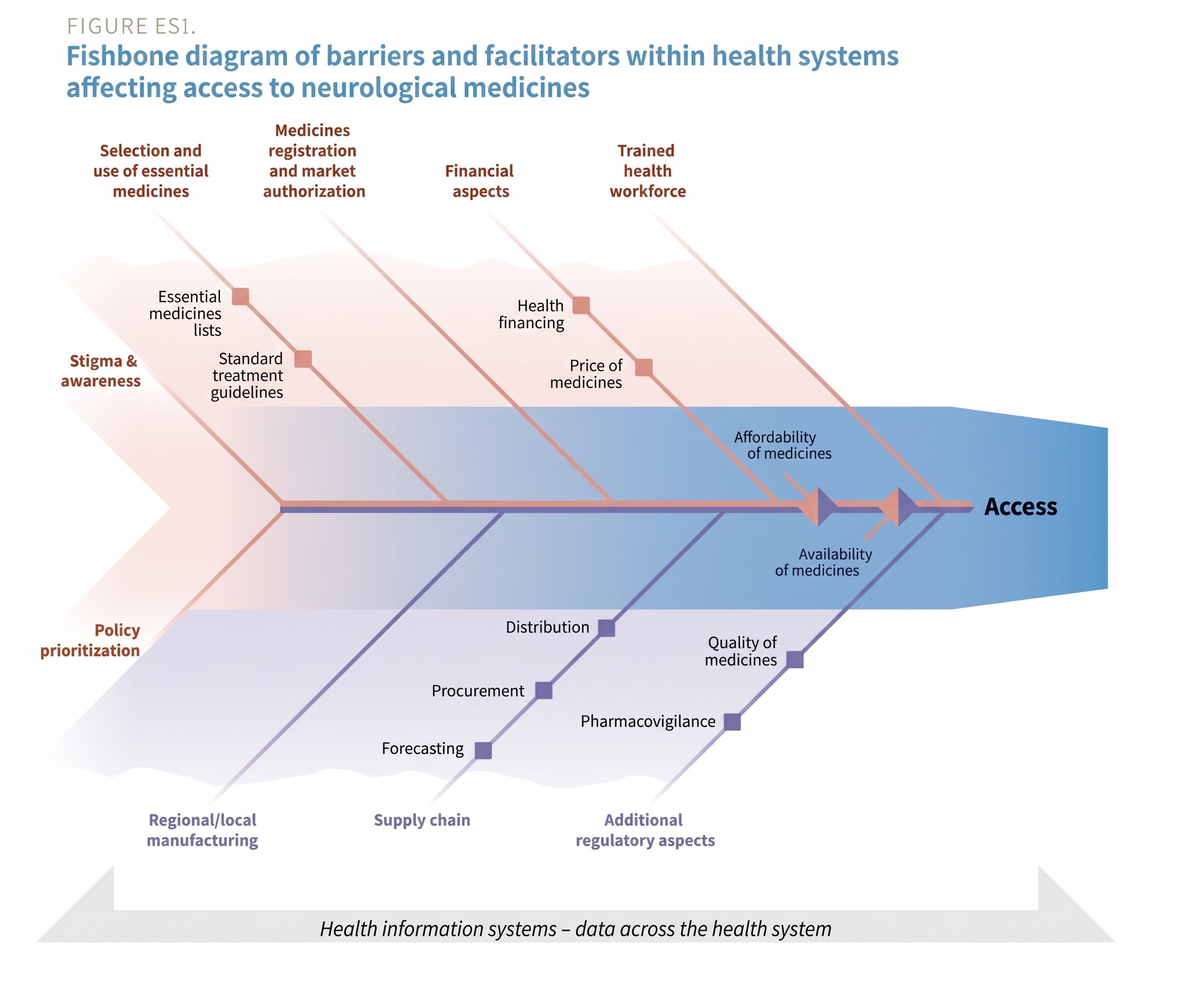
But affordability is only part of the problem: in many countries, essential neurological medicines are not registered or consistently available, meaning that even people who could afford them may simply be unable to access them. WHO’s “fishbone” framework illustrates the many interconnected barriers that can stand between an effective medicine and the person who needs it, from medication registration and financing to procurement, supply chains and a trained health workforce.
The consequences are stark: for example, the treatment gap (the percentage of people who cannot receive treatment) for epilepsy reaches around 75% in most low- and middle-income countries and can be as high as 90% in some low-income countries. Though not systematically studied,the treatment gap for Parkinson Disease is estimated to be similar. In some parts of the world, symptoms such as epileptic seizures and tremors are viewed with suspicion, and people with epilepsy and Parkinson Disease may even suspected of being victims of witchcraft. Even in the less extreme cases, undiagnosed and untreated conditions can leave people shunned and isolated.
Inequitable Access
What makes this lack of access to medication even more inequitable is that many of the treatments are neither new nor expensive. Levodopa/carbidopa for Parkinson disease and phenobarbital and carbamazepine for epilepsy have been included on WHO’s Model List of Essential Medicines (a global catalog of medications needed to meet the fundamental healthcare needs of a population) since its very first edition in 1977. Yet, nearly 50 years later, access remains deeply unequal. Recent data presented at a 2026 WHO AFRO intercountry learning workshop in Lomé, Togo, showed that only 22 countries in the Africa Region reported having at least one essential medicine for mental health and neurological conditions generally available at primary health-care facilities. According to WHO’s Global Status Report on Neurology, only around half of responding low- and middle-income countries report that levodopa/carbidopa is generally available at the primary healthcare level.
Policies and legislation are the cornerstones that help to make access to diagnosis, treatment and care possible. This is part of the invisible work that WHO undertakes with ministries of health and is at the center of the Intersectoral Global Action plan on Epilepsy and Other Neurological Disorders (IGAP) adopted by WHO’s Member States in 2022. This global plan gave WHO a unique window of opportunity to work with countries to strengthen the policies, financing, workforce, medicines access, and primary care systems required for long-term impact.
To widen access to care and to these life-changing medications involves a number of different steps - all of which take place at the policy and systems level, and which are set out in the WHO IGAP.
A Path Forward
First: we need to know the scale of the problem. In many countries people living with neurological conditions are invisible. They often aren’t included in the data that health workers routinely report to health authorities. This means there is limited data available to show who needs medication - which means there is no pressure on governments to develop procurement policies or to find the funding needed.
Second: systems need to be put in place for affordable and equitable access to medication which includes accurate data on need, strengthening supply chains and engagement with manufacturers to expand access.
Third: policies need to be formulated that reflect the realities within primary care systems. The statistics make for sobering reading: there are an estimated three neurologists for 1,000,000 people on average in low income countries, which WHO estimates is over 80 times lower than that of high-income countries.
Realistically this means the majority of people in the world with a neurological condition will never be able to see a specialized doctor. For Parkinson Disease, studies in some low and middle income communities suggest that fewer than one in four people living with the condition are diagnosed, leaving many without access to appropriate treatment and care. One answer is to change the culture of healthcare delivery through policy changes so that general doctors, nurses and other healthcare workers can prescribe medication and so they are sufficiently trained to diagnose a neurological condition in the absence of a specialist. This involves training and capacity building, all of which takes investment. Investment in terms of resources and investment in the sense of a commitment to a better future.
The good news is that change is already happening. WHO is working with countries, in particular in the African Region, to improve access to essential neurological medicines by tackling the barriers that keep treatments from reaching people – from affordability and procurement to supply chains, prescribing policies and the capacity of primary healthcare workers.
Early results show what is possible. In Ghana, levodopa/carbidopa has been added to the national Essential Medicines List and Standard Treatment Guidelines. Tanzania undertook its first-ever government procurement of the medicine in 2024, while Kenya is advancing changes to enable neurological medicines to be prescribed at primary care level. The WHO Foundation is now mobilizing and pooling resources from partners to help WHO take this work to more countries and reach more people.
As research continues to pursue better treatments and, ultimately, cures for some neurological conditions, we must also ensure that the treatments available today reach millions of people who can benefit from them – no matter where they live or what they can afford.