The WHO diagnostic skin app is helping clinicians and patients in Kenya in the treatment of troubling skin conditions.
In two health facilities near Nairobi, Kenya, healthcare workers face enormous challenges every day: overcrowded clinics, long distances between patients and care, shortages of specialists, and limited diagnostic tools. Yet within these constraints, a simple smartphone app is beginning to change how skin diseases are identified and treated. The WHO Skin NTDs app uses artificial intelligence (AI) to help frontline health workers recognize neglected tropical diseases (NTDs) and common skin conditions. By photographing a patient’s skin lesion in the app, clinicians access a list of possible diagnoses to support their own clinical judgment and help them decide the next course of action.
We spent time with frontline health workers and patients to see how the app is being used and the ways in which it is becoming embedded within clinical practice. Their stories also shine a light on how digital tech can strengthen the decision-making of health workers and empower patients to advocate for their own health.

Florence, head nurse at a dispensary
Every Thursday, Florence braces herself for what she knows will be a tough day. At the dispensary near Nairobi, where she works, Thursdays are reserved for the skin conditions clinic. Cutaneous leishmaniasis (CL), a parasitic disease spread by sandflies that causes skin lesions, is endemic in the area. The treatment for the condition involves a series of painful injections that can leave patients in tears. “It can be emotional sometimes,” she says. “But that is the only way you can help.”
The clinic sees around 30 patients a day for conditions ranging from eczema to fungal infections and CL. Resources are extremely limited: there is no running water, no laboratory, and often Florence is the only nurse on duty. “In case of emergency, there is no ambulance, no transport,” she says. “All we can do is pray.”
Florence first encountered CL through outreach clinics at a local church, where patients sometimes waited all day for visiting clinicians to arrive. Since services moved into her clinic, care has become more accessible, but diagnosing skin conditions remains challenging. “There’s a wide range,” she says. “Sometimes you don’t know what to say to the patient, and I don’t have anyone else I can ask.”
For years, in the absence of diagnostic tests or colleagues to consult, she had to rely on her clinical judgment for diagnosing CL. Recently, trainers from Amref Health Africa, one of the continent’s largest health-focused nongovernmental organizations, have been teaching staff how to take samples for CL and send them to the lab for confirmation. To make sure they arrive, Florence goes out of her way on her journey home to deliver the lab samples in person.
The clinic has also begun using the WHO Skin NTDs app to support diagnosis. Previously, if patients came in with a condition Florence couldn’t identify, she would refer them to a dermatologist, a two-hour walk away – and hope they would go. In a country with few dermatologists, patients may have to wait weeks between the referral and their appointment. In that time, their condition is likely getting worse. Now, with the app, Florence can diagnose with more confidence. Working with rural communities who often cannot access care, she wants to be able to treat more skin conditions herself without having to refer patients. “We are trained to do so much, but we are not specialists,” she says. “If we didn’t need to refer the clients to the dermatologist so often, that would be good. In the end, all we want to do is help the patients.”

Ben, clinical officer
Ben has worked at the same county referral hospital for a decade, but his life almost took a very different path. As a child, he lived through Kenya’s tribal clashes, watching his family lose everything overnight. Years later, angry and directionless, he joined a criminal gang and worked at his uncle’s casino, until his brother called to say he had secured Ben a spot at Kenya Medical Training College. “I don’t know how he did it, I didn’t even know what clinical medicine was,” Ben says. “But it gave me a chance.”
.jpg)
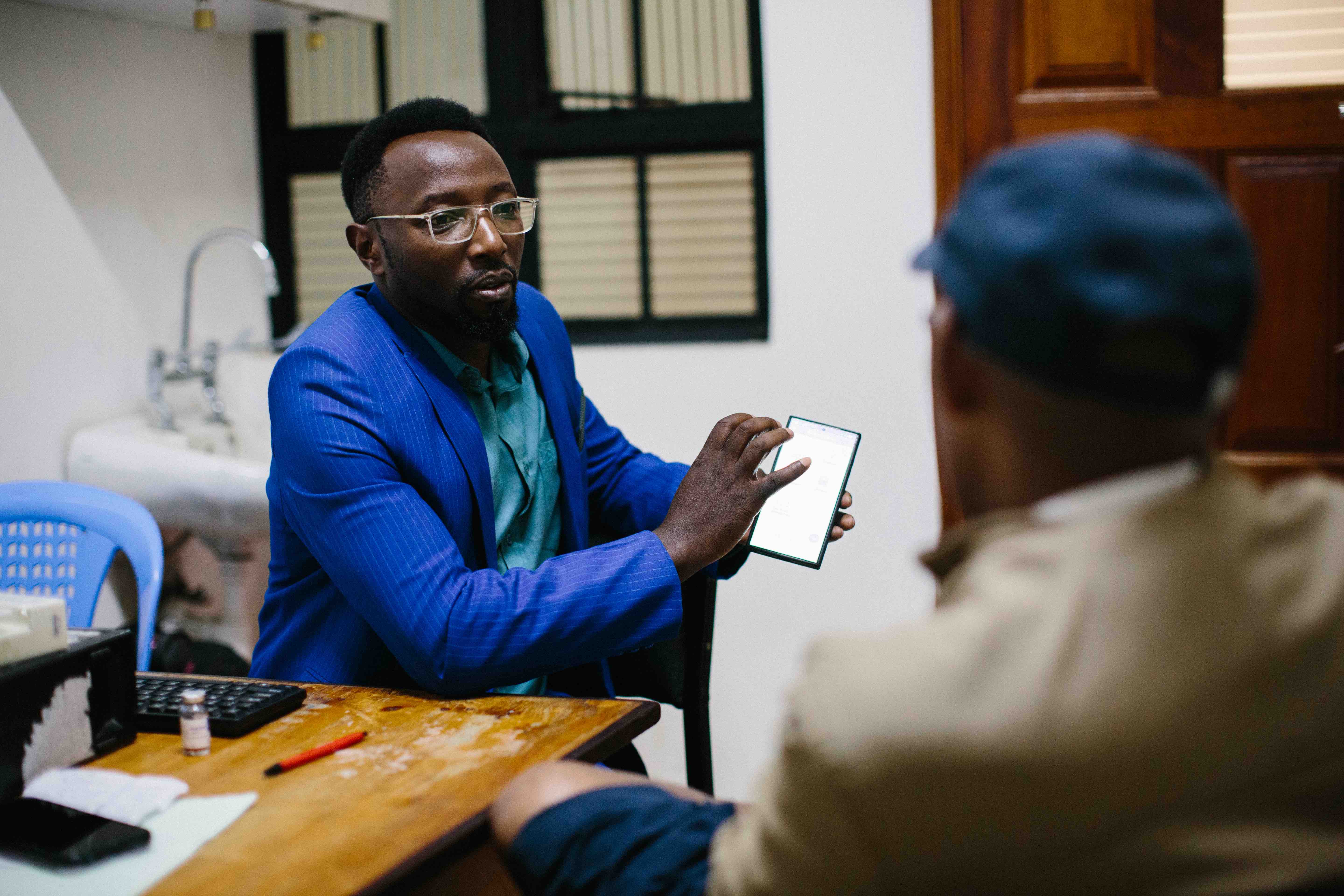
Today, Ben leads outpatient services at the hospital, where he says skin conditions had long been neglected. “Whenever most clinicians see a patient with a skin condition, they don’t even take time with them – they just refer,” he explains. “We don’t have the right training.” That changed for him in 2024 when he began using the WHO Skin NTDs app. Ben says the app gave him the confidence to manage conditions he once avoided. “It’s an eye-opener,” he says. “Not only for me and the other clinicians here, but for healthcare in Kenya.” Now, instead of immediately referring patients, Ben spends time discussing symptoms, explaining possible diagnoses and often starting the patient on treatment. Recently, he nearly missed a scabies diagnosis in a child until the list of potential diagnoses on the app prompted him to ask more about the patient’s symptoms.
“If not for the app, I would have concentrated on the lesions on the child’s legs and missed those on their arms,” he says. “When we checked all of the symptoms, they were consistent with scabies.”
Ben says using the app has made him proactive about building up his own knowledge of skin conditions. Whenever it gives him a diagnosis he’s unfamiliar with, he will take the time to read about the disease to prepare himself for the time a patient may come in with it. “Education is power,” he says. The app’s greatest value for him, however, lies in helping frontline clinicians care for patients who are often stigmatized and overlooked. He recalls the time before he started his journey into medicine when he had to walk for eight hours carrying his sick daughter to get to the nearest hospital, only to have to argue with the doctors to get them to take her illness seriously. Eventually, they discovered she was suffering from gastroenteritis and she got the treatment she needed. But he doesn’t want any of his patients to ever experience what he went through.
“Our patients are the most needy people,” he says. “So, we attend them with care, attend them with love, and walk their walk.”
.jpeg)