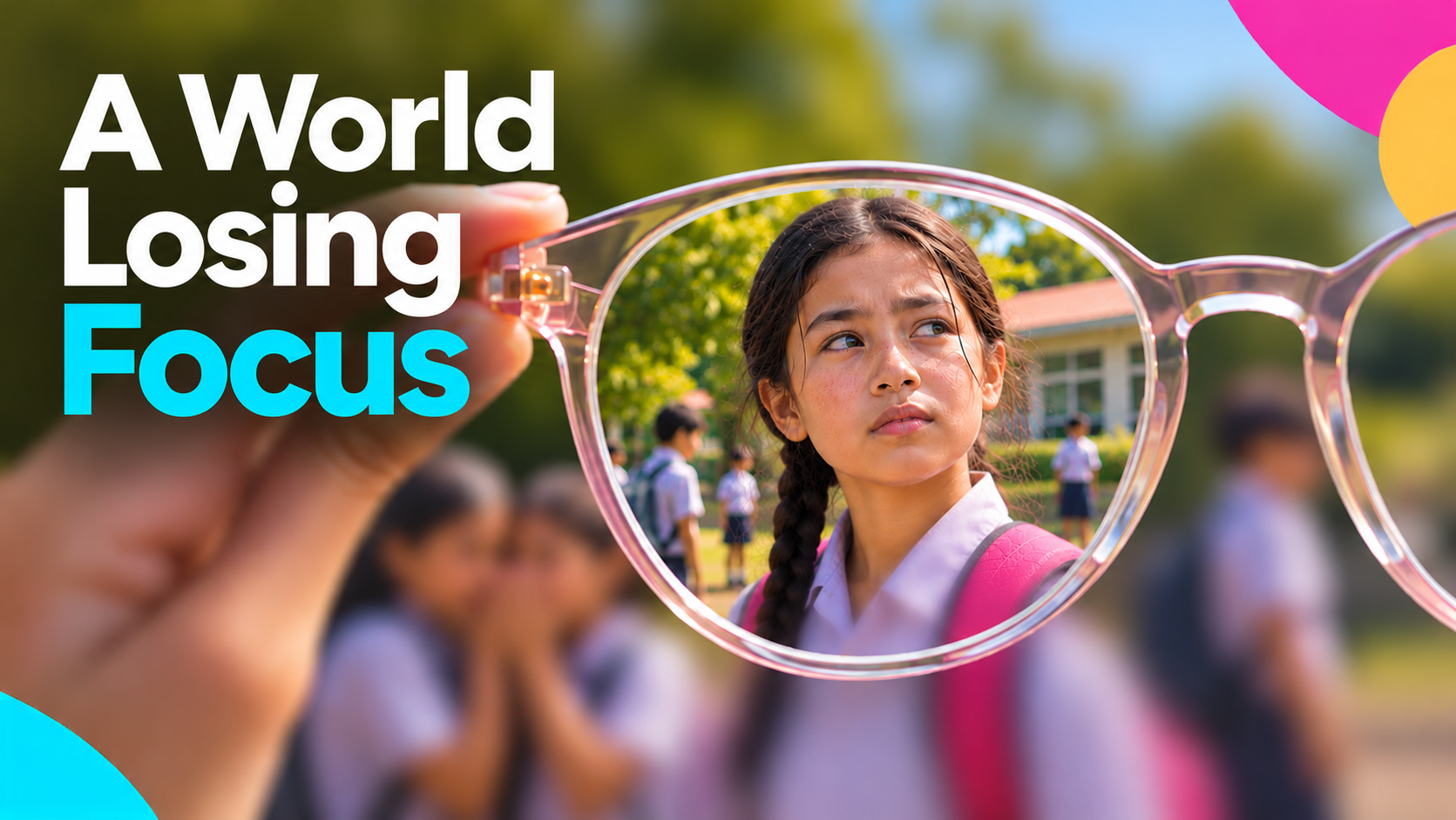
Billions of people are affected by short-sightedness, yet misinformation, unequal access to care and missed opportunities for prevention continue to put sight at risk. The World Health Organization (WHO) is working to change that, combining trusted information, innovation and stronger health systems.
Myopia, or short-sightedness, was estimated to affect 2.6 billion people worldwide in 2020. By 2030, that number is projected to rise to 3.36 billion; an increase of approximately 760 million people in just a decade. More concerning still, the number living with high myopia, which carries a greater risk of irreversible vision loss, is projected to grow from 399 million in 2020 to nearly 517 million by 2030 - learn more in WHO & ITU’s MyopiaEd Toolkit
Myopia causes distant objects to appear blurred. For children, this can mean struggling to read a classroom board or participate in sport. For adults, everyday activities, from driving to working, become harder. While glasses can correct blurred vision, addressing myopia requires more than vision correction alone; it needs greater awareness, early action, and appropriate ongoing care. High myopia increases the risk of serious complications, including retinal detachment, glaucoma and irreversible vision loss.
Misinformation persists
Genetics contribute, but lifestyle matters too. Prolonged close-up activities, including reading and screen use, are associated with greater risk, while spending time outdoors helps protect children. Yet understanding of myopia, its risks, and steps to support eye health remains limited, and misinformation persists.
The misconception that spectacles worsen eyesight, alongside stigma and teasing, discourages children from wearing glasses. A review of 23 studies found that only 40% of children and adolescents wore prescribed spectacles as recommended.
Public education can make a difference. Singapore's national program combined school screening with education for families and teachers. Between 2004 and 2015, this intervention reduced myopia prevalence among primary-school pupils from 37.7% to 31.6%, demonstrating the potential of coordinated action.
WHO's World report on vision called for eye care to become integral to universal health coverage, recognizing that informed communities are essential to prevention and treatment. Together with the International Telecommunication Union, WHO developed MyopiaEd, a digital education program that sends evidence-based messages by text and other digital channels. It encourages habits that can delay the onset and slow the progression of myopia, such as spending more time outdoors and spending less leisure time on screens, along with regular eye examinations and wearing glasses as prescribed. It also addresses common misconceptions about myopia, with separate message tracks for parents and caregivers, educators and health workers, and adolescents and adults with myopia.
Expanding digital eyecare
Through its new partnership with Santen, a global healthcare company dedicated to eye health for more than 135 years, the WHO Foundation is supporting MyopiaEd's expansion, updating messages with the latest evidence, tackling misinformation and adapting communications to local needs. Beginning in four countries, the initiative will test approaches that governments can replicate and scale, making trusted eye-health information more accessible.
Technology is creating new possibilities for eye care, particularly in communities where specialists are scarce. Artificial intelligence can help analyze retinal images, smartphones can support vision screening, and digital messages can connect people with care. But technology alone is not enough.
In Kenya, a study published in The Lancet Global Health demonstrated the power of combining digital tools with human intervention. Teachers in 50 primary schools used smartphone-based vision screening, illustrated referral information and text reminders to help children access eye care. The results were striking: 54% of children referred through the program attended their hospital appointment, compared with 22% receiving conventional screening and referral.
The lesson is clear: technology can identify a problem, but trusted people, clear information and practical support help turn that knowledge into action.
Myopia is one part of a much wider global challenge. At least 2.2 billion people live with vision impairment, including at least one billion whose condition could have been prevented or has yet to be addressed. Cataract alone affects more than 94 million people worldwide, despite the availability of highly effective surgery that can restore sight. Yet access remains deeply unequal. In lower-income countries, shortages of trained professionals, unaffordable treatment and weak health systems mean millions continue to live with avoidable vision loss.
Effective cataract treatment
WHO is responding through SEE, a global initiative to eliminate cataract-related blindness and vision impairment as a public health problem. Building on WHO's global target for 2030, a 30-percentage-point increase in effective cataract surgery coverage, SEE is built around three priorities: Screening, Equitable access and Effective surgery. It aims to strengthen case detection and referral, reduce barriers to access and out-of-pocket costs, strengthen the workforce and surgical supply chains, and ensure good and equitable outcomes. Because cataract is largely driven by aging and cannot be eliminated, the goal is 90% coverage of effective cataract surgery by 2045. Like MyopiaEd, SEE reflects a fundamental principle: lasting progress requires more than individual interventions. It requires health systems that can deliver effective, affordable care to everyone, regardless of income or geography.
The stakes are both human and economic. Uncorrected myopia alone is associated with an estimated US$244 billion in annual global productivity losses. But the greatest returns are measured in lives transformed: a child able to learn, an adult able to work, an older person regaining independence.
WHO provides the global leadership, scientific guidance and partnerships with governments needed to turn these opportunities into lasting change. Through the WHO Foundation, partnerships such as the collaboration with Santen on MyopiaEd demonstrate how targeted contributions can support programs that translate evidence into practical solutions, while initiatives such as SEE extend that impact across the wider eye-care system. For partners, the opportunity goes beyond funding individual programs. It is to help build sustainable systems, accelerate innovation, and make equitable access to eye care a reality.
The world already has many of the tools to prevent avoidable vision loss. What it needs now is the collective commitment to ensure they reach everyone. Because the right to sight should never depend on where someone lives or what they can afford.
For more information on how to support eye care projects, contact Vanessa Rouselle, WHO Foundation's Head, Strategic Partnerships.

