The WHO Foundation
Transparency & Independence.
At the WHO Foundation, we are committed to transparency, accountability, and integrity in all aspects of our work. To help you understand how we operate, we want to share some details about our fundraising practices.
Our commitment.
The WHO Foundation exists to mobilise resources for urgent global health challenges while safeguarding the integrity and independence of WHO. As a donor to WHO, the WHO Foundation provides funding through grant allocation letters, specifying how funds are intended to be used. We collaborate with WHO programme teams to identify opportunities — but WHO's health policies and programmatic decisions remain fully independent. Our relationship is governed by a formal Affiliation Agreement that defines clear boundaries between our organisations.
How we operate
Funding transparency.
We are an independent Swiss non-profit that mobilises private and philanthropic support for WHO and its mission. Here's how we protect that independence.

How we accept gifts
All gifts must advance public health in line with WHO's General programme of Work and align with our Gift Acceptance Policy and the principles of WHO's Framework for Engagement with Non-State Actors (FENSA).
Every prospective donor undergoes compliance screening. Gifts exceeding US$100,000 are reviewed by our Gift Acceptance Committee.
We do not accept funds from the arms or tobacco industries, or from any party under sanctions.

Donor recognition & anonymity
We publicly acknowledge contributors for gifts of US$100,000 or more. In line with GDPR and data protection rules, we always request donor permission before disclosing their information.
Some donors opt for anonymity. However, no gift or donor is ever unknown to the WHO Foundation —the same due diligence applies to all. Anonymous contributions accounted for about 5% of total funds raised (2021–2024).

How Funds flow to WHO
Once a gift is accepted, we issue a grant allocation letter to WHO specifying purpose and intended use. We apply a single, shared indirect rate agreed with WHO to avoid duplicative overheads.
Funds are transferred to WHO (or other grantees),which then allocates them to relevant programmes for their intended use. We report on the achievement of intended outcomes.

Independent Review
In 2025, the WHO Foundation commissioned CCS Fundraising to conduct an independent evaluation of its first five years of operations (2021–2025).
The evaluation found that the Foundation has built a credible, high-performing platform for fundraising at scale, mobilizing approximately US$215 million for WHO over five years, engaging 84 new donors, and broadening the diversity of WHO's funding base. It also identified areas for continued development, including donor pathways, systems, governance, and managerial depth.
We invite from any source the reporting of concerns with how funds are used or other violations of laws or our policies. This is possible through our independent Whistleblowing platform, including an external reporting service.
Archive of reports & financial statements
Our latest reports.
To promote openness, we regularly publish Annual Reports, Audited Financial Statements, and Contribution Tables showing source, amount, and use of funds.
Here you'll find quick access to the most recent reports, with all previous years available in the archive below.
Archive — Reports
Archive — Financial Statements
WHO also publishes contributions from Member States and non-government supporters (including amounts from the WHO Foundation) on open.who.int.
Frequently asked questions
We believe in answering directly.
These are the questions people ask most frequently about our funding practices, independence, and relationship with WHO.
For further information or media inquiries, please contact: media@who.foundation
No, it does not.
The term “anonymous” or “undisclosed” in reference to donations in our contribution tables and annual reports simply means that a donor’s name is not made public. However, all donors are fully known to the WHO Foundation and are subject to a comprehensive due diligence Framework, which is in place to ensure that every donor and gift comply with the principles of WHO’s Framework for Engagement with Non-State Actors (FENSA).
These principles include transparency, accountability, scientific independence, and alignment with WHO’s global programme of work.
The largest previously anonymous donor to the WHO Foundation is the Hans Wilsdorf Foundation — a philanthropic institution with a tradition of discretion whose contributions support WHO Foundation operations, not WHO’s programmes. Other philanthropic donors initially listed as anonymous include the ELMA Philanthropies and the Ford Foundation, both of which have since agreed to the public attribution of their support.
The WHO Foundation categorically states that contributions received do not influence either WHO’s policies or priorities within its mandate. WHO and the WHO Foundation are independent entities whose relationship is governed by an affiliation agreement. A donor that attempts to impose conditions on WHO or to influence its decision-making would be rejected.
Anonymous contributions represent approximately 5%of all funds contributed between 2021 and 2024 — declining from around 8% in 2021 to about 1% in 2024. Anonymous does not mean unknown. All donors are fully identified and verified by the WHO Foundation. Our Gift Acceptance Policy and Due Diligence Framework ensure that all donations align with WHO’s mission and adhere to strict public health and ethical standards.
Anonymous giving is common in charitable fundraising, as some donors wish to retain privacy and choose not to disclose their gifts. Anonymous does not imply influence. Sometimes it is the opposite, and some donors stay private to minimize any influence or perceived benefit to the donor.
No, they are distinct entities.The WHO Foundation is a legally independent Swiss foundation established in 2020 to mobilize resources in support of WHO and its mission. It serves as a donor to WHO, advocating for global health financing, brokering relationships with donors, raising funds, transferring them to WHO, and reporting on their impact.
The World Health Organization (WHO), by contrast, is a specialized agency of the United Nations responsible for directing and coordinating international public health efforts.
Donations to the WHO Foundation have no influence on WHO’s policy-making, which remains within WHO’s sole discretion as per its mandate and governance.
The WHO Foundation’s donor base is diverse and includes philanthropic foundations, individuals, and companies, which together contributed more than USD 100 million between 2021 and 2024. Contributions from these donors represent less than 0.5%of WHO’s overall annual budget.
Transparency and accountability are at the heart of everything we do. To make it easier for partners and the public to understand how we operate, our Transparency and Independence page offers direct access to the below key documents and information:
- The Affiliation Agreement between WHO and the WHO Foundation
- Our Gift Acceptance Policy
- Annual Reports, Financial Statements, and Contribution Tables
These resources reflect our unwavering commitment to openness, responsible stewardship, and continuous improvement in the way we share information and build trust.
Our People
Who you’ll be working with
The power and potential of the WHO Foundation starts with our staff.
Leadership Team






Our Board



Featured Donors
Working together for global health.
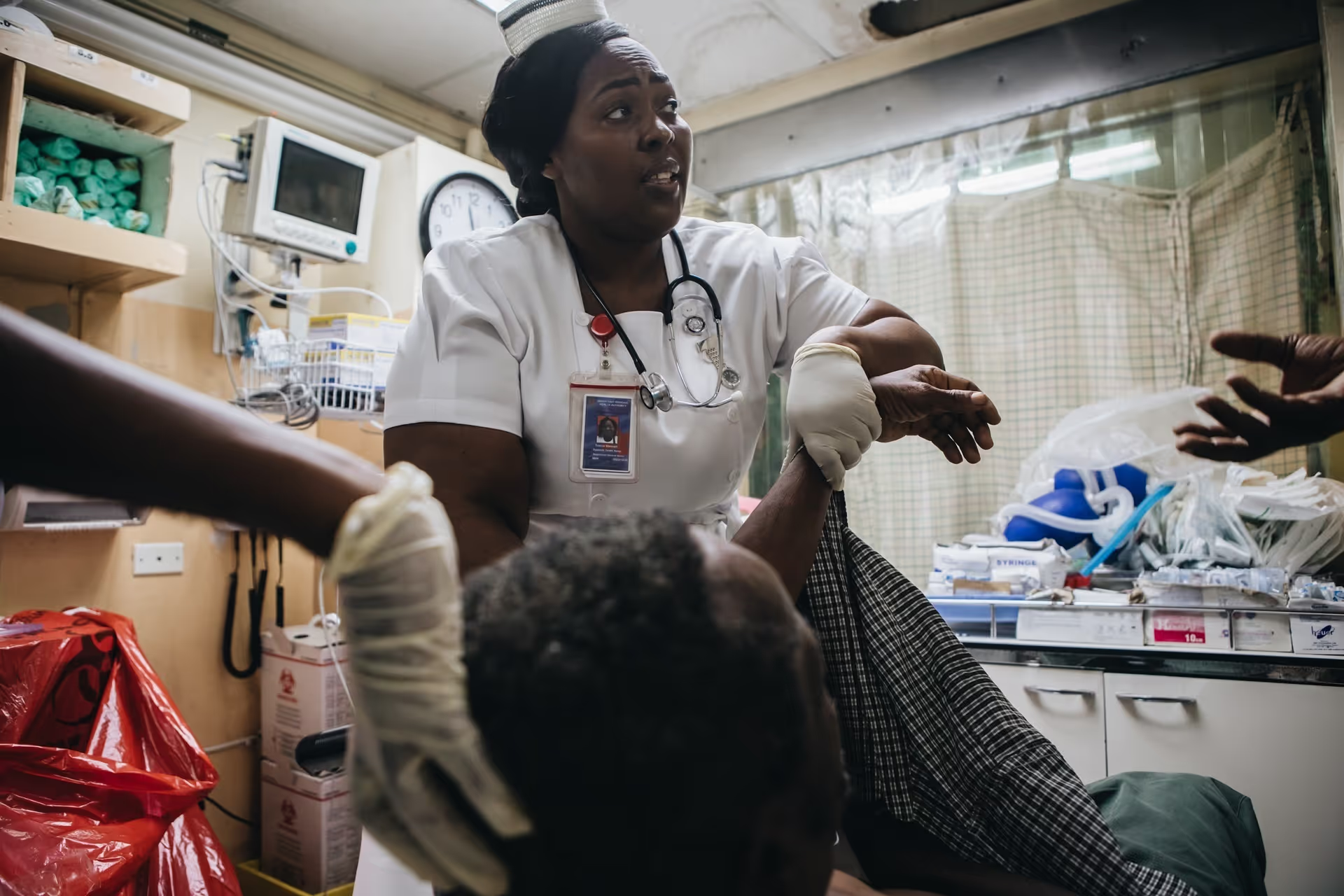
Reducing deaths from critical emergencies by equipping health workers with life-saving techniques
Let's build something
world changing
together.
Speak with our expert team about the latest global health opportunities, and alignment with your funding priorities and values.